
01
The loudest voice wins
Almost nobody pointed to a documented, peer-reviewed lifecycle map as what’s setting strategy.
 customer.ioResearch report
Customer.io research / Drive 2026
Greetings from
Stowe, Vermont
Standing in our workshop with a sticker in your hand, working out exactly where your email program falls on nine different spectrums turns out to be much harder than it sounds—especially once the answer is going up on a wall next to everyone else’s.
Before Drive, we ran the same questions as an online pulse check. This report puts the two side by side.
The TLDR: Marketers trust email, but most haven’t proven its impact.

The reality check / Key findings
Almost nobody pointed to a documented, peer-reviewed lifecycle map as what’s setting strategy.
Lifecycle tends to stay a solo job longer than other marketing roles before a company invests in a real team.
Bitly’s best email asked one honest question with no CTA. It pulled 2.5× their normal reply rate.
Every table agreed: nobody trusts AI to personalize live or at scale without a person checking it.
72% run a mix of manual and automated campaigns. Only 3% said fully automated.
Only 17% said stopping email would cause a serious hit. Most landed between “barely a dent” and “not sure.”
The audit
Each signal includes the prompt as it appeared in the room, what your peers said live, what 210 marketers said before the workshop, and a tactical fix to try this week.
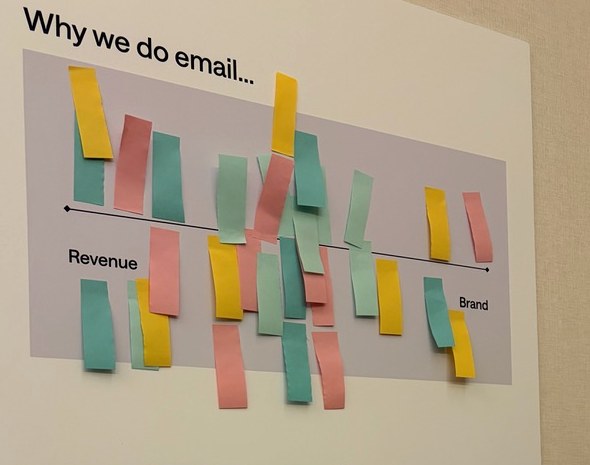
Revenue and brand are tied in this room. Nobody’s settled which one email is for.
58% of respondents named email as the channel that drives their best ROI, more than SMS, in-app, and push combined.
The room’s even split probably isn’t indecision so much as different marketers each having a clear, different answer. E-commerce and PLG teams lean revenue; brand-led or content-heavy teams lean brand. Some marketers reject the premise entirely because a single email can do both jobs at once.
Treat email as a conversion channel first. It builds awareness along the way, but that’s a side effect, not the job it’s there to do. If your team gets evaluated on brand lift, but the emails you’re sending are automated, revenue-driving campaigns, you’re measuring the wrong thing.
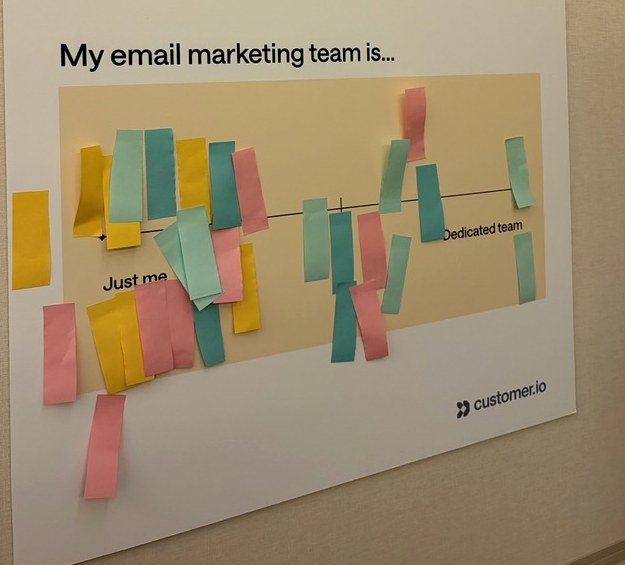
Most people in the room are either working solo or running a full team, without much of a middle ground.
Team size shapes what’s possible more than it determines what’s smart: solo marketers tend to move faster and experiment more; bigger teams are better positioned to scale what’s already working.
Lifecycle tends to stay a one-person function longer than other marketing roles. Companies often jump from solo to a proper pod once headcount gets approved rather than growing gradually.
At Customer.io, we don’t have a single “email team.” Growth marketers use email to drive product adoption, product marketing uses it to launch features, demand gen uses it to nurture and send content and resources, and the list keeps going.
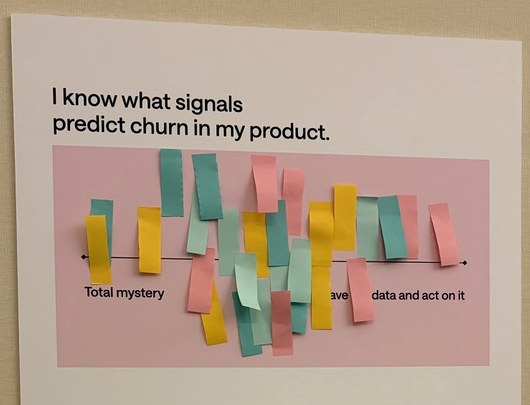
Most of the room knows there’s a signal worth watching for churn, but isn’t acting on it yet.
Only 26% track churn signals and act on them. 50% have “some idea, but no action on it.” 25% called it a total mystery.
Three out of four marketers either can’t name what predicts churn or can name it and still aren’t doing anything about it. Churn signals live in product analytics tools that most marketers can already see, but acting on them requires lifecycle infrastructure—a trigger, a journey—that most teams haven’t built.
There’s an ownership layer underneath that too: the signal sits with whoever owns product data, while the response sits with marketing.
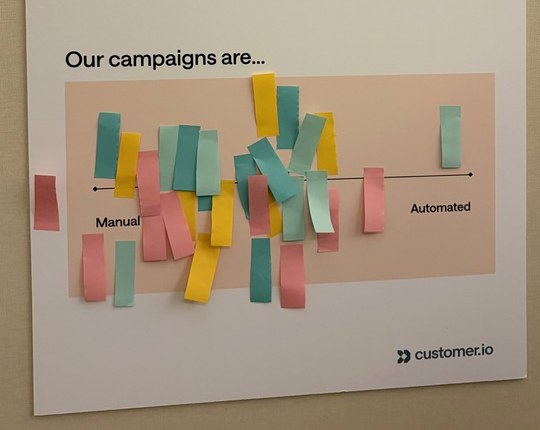
Manual still wins in this room. Full automation is rare, and the gap is wider than our pre-event survey.
72% run a mix of manual and automated campaigns. Only 3% are fully automated, and 25% are still mostly manual and one-off.
“Somewhere in between” is the norm, and “fully automated” stays rare even in a room full of people who focus on email for a living.
Automation isn’t the goal. It’s what buys you the time to do the parts of the job a workflow can’t: strategy, judgment, the actual thinking.
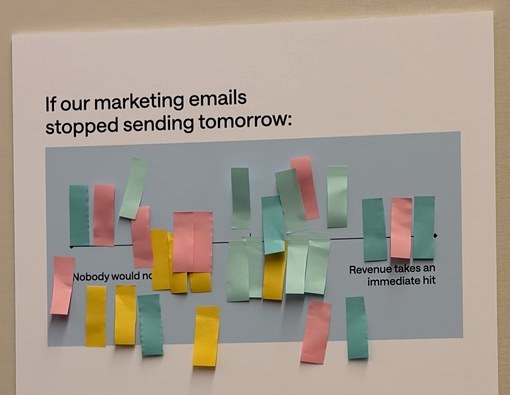
Most of the room thinks losing email would cause a dip, not a crisis.
35% said a noticeable dip, 27% said barely a dent, 21% weren’t sure, and only 17% said a serious hit.
Fewer than one in five marketers are confident their email program is revenue-critical. We think this room is underrating its own impact.
Email rarely gets full credit in a standard attribution model because it influences a decision without closing the last click. Being unsure whether email is revenue-critical usually means the attribution is broken, not that the channel isn’t working.
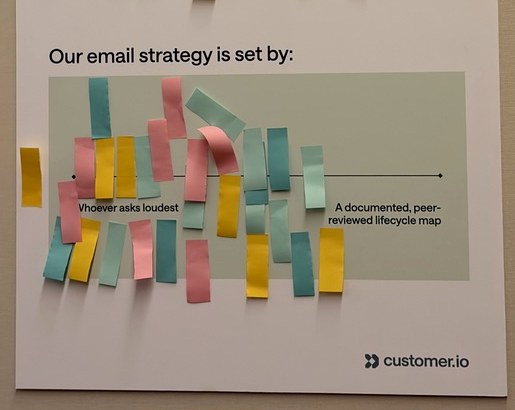
Strategy in this room is set by whoever pushes hardest, not by a documented plan.
59% said reporting and measuring success is a top challenge, and 57% said their systems and data are out of sync.
Whether you’re the most junior person on the team or the one who signs off on budget, a documented strategy makes your job easier. It gives you something to point to instead of re-litigating priorities every time someone makes a loud ask—and gives whoever you report to a clear reason to trust your calls.
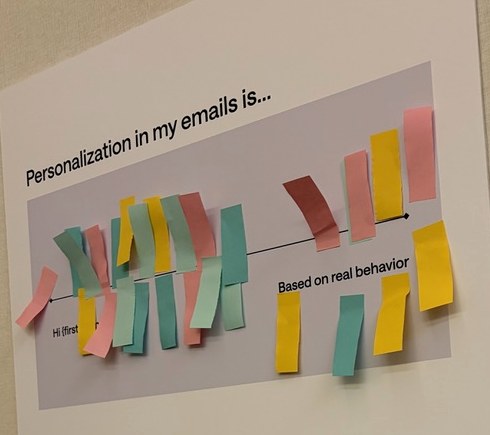
The room split. Several people pushed back on personalization as the goal at all: what they wanted was relevance—the right message at the right moment.
When asked what they’d fix with a magic AI wand, marketers put automation and data integration ahead of personalization.
People want messages that feel earned because they’re tied to something real: a job title, product usage, past content, behavior. One marketing leader at a B2C freemium company said an AI-driven personalization step they tried “didn’t get close enough” without more first-party data.
Relevance is the right goal. Personalization is the mechanism teams reach for first because it’s easier to build than real relevance is.
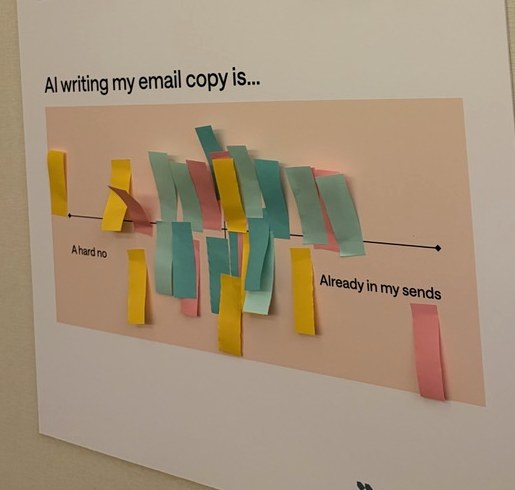
This room uses AI everywhere in their workflow, but they’re not handing it the publishing and sending role.
84% are cautiously optimistic or excited about using AI in their email program. Only 6% are skeptical. Average self-rated adoption: 6.7 out of 10.
High AI adoption and staying hands-on aren’t in conflict. AI can draft, suggest, and save time, but the sentence a customer reads still gets a person’s judgment before it ships. This is still a human craft.
The bigger opportunity sits upstream: surfacing the moment a customer is ready to hear from you, finding the relevance that makes a message worth sending, and organizing scattered research into something usable.
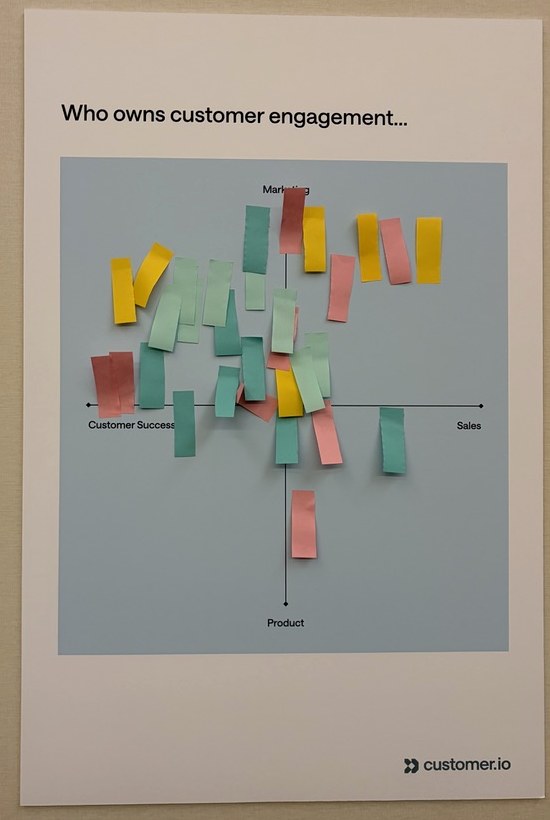
Marketing owns customer engagement among this group, with close collaboration with CS, sales, and product teams.
Owning engagement doesn’t mean marketing works alone. The programs that work best are the ones where marketing sets the strategy and pulls in the right team at the right moment: Product for usage signals, Customer Success for what’s frustrating people, Sales for what made a deal close or stall.
Ownership is about who’s accountable for the outcome, not about doing all the work alone. Owning engagement means owning that handoff.
Once people got specific
Here’s what came out of small-group discussions once we pulled the room back together.
“Not all emails are worth sending. A tighter series beats a bigger blast every time.”
“The fix for generic AI copy wasn’t a better prompt. It was reading more—real books, real writing.”
“For one table, the most honest answer was “nothing.” For another, consistency changed everything.”
Case study / Bitly

Luke Reynebeau, VP of Product Marketing at Bitly, joined us for a fireside chat to close out the session. Bitly started as a URL shortener and has expanded well beyond that, and its lifecycle and customer marketing functions now sit inside a broader product marketing org. The whole conversation ran on one piece of framing from Luke: every email is a brand moment, not only a conversion attempt, whether it's driving revenue or not.
Bitly has moved away from “Hi {first_name}” personalization toward what Luke described as reflecting real data back at someone, closer to a Spotify Wrapped moment than a mail-merge variable. Segmentation does more work for them than personalized copy does. They’re consolidating their programs onto a single platform across both of their products specifically to make that kind of reflection possible at scale.
Devin’s team sent an email to their most engaged free users with no call to action, no link back to the product, and no mention of Bitly at all. The entire ask was a single open question: name one thing you’d like advice on. They reserved it for the already-engaged segment first, defined by recent email opens and product activity, and Devin replies personally to real questions that come back, a practice the team maintains across the program, not only for this one send. The email got 2.5 times Bitly’s typical reply rate and a 50% open rate, against a normal range of 35 to 45% for free-tier sends. Close to half the replies turned into informal product feedback that got routed straight back to product, and it became a repeatable format, an “advice inbox” follow-up, instead of a one-off experiment.
Luke was direct that lifecycle strategy is a balance, responding to what the business needs on one side, pushing back with data on the other, not something set in a vacuum. Bitly’s lifecycle team brings quantitative understanding of their customers into product and launch conversations, which is what gets them included in planning a launch instead of finding out about it the week it ships. That credibility gets built one accurate read at a time, not granted upfront.
Free users get one email a week, gated by relevance, people who stop engaging fall off the list rather than getting emailed into oblivion. Onboarding sequences run at a higher velocity, up to daily, but stop the moment a customer hits the milestone they’re aimed at. Paid customers get touched less often, biweekly to monthly, with heavy suppression logic so nobody gets a generic broadcast and a triggered send in the same week.
Bitly ran a version of this same “no ask” idea around the Super Bowl: an email that simply acknowledged their customers don’t have a Super Bowl-sized marketing budget either, no product mention, no CTA, only a human moment. It pulled a wave of goodwill replies. Pick one moment your customers are already feeling (a season, a shared frustration, a shared constraint) and send something that names it without asking for anything back. The engagement comes from being seen, not from being sold to.
At a glance
| Poll | The pattern | Why it happens | Try this |
|---|---|---|---|
| 01Revenue vs. brand | No consensus, the room is split | Different business models want different things from email | Split last month's sends by call to action, then measure revenue sends by conversion and revenue per send, and brand sends by opens and replies |
| 02Team size | Solo or fully staffed, almost no in-between | Lifecycle rarely gets headcount until it's already proven itself | Map who owns each recurring send this week, whatever your team size is |
| 03Churn signals | Most know the signal, few act on it | The signal lives in product data; the response lives in marketing | Build one trigger this week: signal in, message out, no other conditions |
| 04Manual vs. automated | Manual still wins | Automation buys time, but building it costs time too | Automate the one campaign you rebuild by hand most often |
| 05Revenue impact if paused | Most expect a dip, not a crisis | Standard attribution rarely credits email's assist role | Pause your least-missed campaign for two full send cycles and measure the dip |
| 06Strategy ownership | Whoever asks loudest, overwhelmingly | Nobody's forced to write a strategy down until someone asks for it | Draft a one-paragraph strategy from your team's real goals and get it signed off |
| 07Personalization | Polarized: first names or real behavior, nothing between | Relevance takes data infrastructure most teams don't have yet | Swap one static line for a real behavioral trigger and ship the test |
| 08AI writing copy | Already in the workflow, not making the final call | Marketers want AI's speed on the busywork, not its judgment on the message | Ask AI to surface one segment showing a strong signal, then turn that into a one-page campaign brief before anyone writes copy |
| 09Engagement ownership | Marketing owns it, working with CS, Sales, and Product | Ownership means accountability, not solo execution | Set up a recurring 15-minute sync with whoever holds the data you don't have |